
Your daughter’s first period is approaching, and you are wondering how to talk about it without making her feel embarrassed or anxious. Preparing your daughter for her first period does not have to be awkward or clinical. When we approach this milestone with openness and normalize menstruation as a healthy, natural process, we give our daughters confidence that lasts a lifetime.
After talking with dozens of mothers and reviewing what actually helps girls feel prepared (not scared), I have compiled this guide. You will learn exactly what to say, when to start the conversation, and how to handle the emotional side of this transition. We will cover practical preparation tips, shame-free language you can use today, and even ideas for celebrating this milestone positively.
Table of Contents
Understanding the Timeline: When to Expect First Period
Most girls get their first period between ages 10 and 15, with the average age being around 12. However, the normal range is wider than many parents realize. Some girls start menstruating as early as age 8, while others do not begin until age 15 or 16.
The timing depends on genetics, nutrition, body composition, and overall health. If you started your period at age 11, your daughter will likely follow a similar timeline. But there are no guarantees, which is why starting conversations early matters.
The Two-Year Rule
Once breast development begins (the first visible sign of puberty called thelarche), most girls get their period within two years. This means you should start talking about menstruation when you notice breast buds forming, not when the first period arrives.
Puberty typically progresses through predictable stages. Hair growth in the pubic and underarm areas usually follows breast development. Vaginal discharge often appears 6 to 12 months before the first period. These physical signs give you a window to prepare your daughter before bleeding actually starts.
5 Signs Your Daughter’s Period Is Coming Soon
Knowing what to watch for helps you time your preparation conversations. Here are the five most reliable signs that menstruation is approaching:
1. Breast Development
Breast buds appear as small, firm lumps under one or both nipples. This is often the first sign of puberty and typically appears between ages 8 and 13. Periods usually start within 2 years of this development.
2. Pubic and Underarm Hair Growth
Fine hair appears first, gradually becoming darker and coarser. This usually starts 6 to 12 months after breast development begins and signals that hormonal changes are accelerating.
3. Vaginal Discharge
Clear or white discharge in underwear is one of the most reliable predictors. When you notice this consistently for several months, it usually means the first period will arrive within 6 to 12 months.
4. Growth Spurt
Girls typically grow 2 to 3 inches per year during the growth spurt that precedes menarche. The hips widen and body composition shifts. This rapid growth phase signals that reproductive maturity is approaching.
5. Emotional Changes and PMS Signs
Mood swings, irritability, or sensitivity to criticism may increase as hormones fluctuate. Some girls experience mild cramping, bloating, or breast tenderness before their first period arrives.
How to Talk to Your Daughter About Her First Period
The biggest mistake parents make is waiting for the “right time” to have one big talk. Research and real parent experiences show that ongoing, casual conversations work better than a single serious discussion.
Start Early with Small Conversations
Begin talking about bodies and how they change when your daughter is around 8 or 9 years old. You do not need to explain everything at once. Start with simple concepts and add detail as she ages.
Use everyday moments as natural openings. A TV commercial for pads, a mention of someone buying tampons at the store, or even a question about why you keep supplies in the bathroom can spark a conversation.
4 Steps to Starting the Conversation
Step 1: Check your own comfort level first.
If you feel awkward, your daughter will pick up on it. Take a breath and remind yourself that this is biology, not something shameful. Your confidence sets the tone.
Step 2: Use factual, direct language.
Say “period” and “menstruation” rather than euphemisms like “that time of the month” or “Aunt Flo.” Clear language reduces confusion and stigma.
Step 3: Explain the biology simply.
“Every month, your uterus prepares a cozy lining in case a baby needs to grow there. If there is no baby, your body does not need that lining, so it comes out as blood through your vagina. This is called a period.”
Step 4: Invite questions and stay available.
Ask, “What questions do you have?” rather than “Do you have any questions?” The first assumes she will have questions; the second suggests she should not.
Shame-Free Language: Exact Phrases That Help
Parents consistently tell me they want specific phrases to use, not just general advice. Here is what to say and what to avoid.
Phrases That Normalize and Support
“Getting your period means your body is working exactly as it should.”
“This is something half the people on Earth experience. It is completely normal and healthy.”
“Some people feel excited about their first period, some feel nervous, and some feel both. However you feel is okay.”
“If you ever need supplies at school or a friend’s house, just ask. There is nothing embarrassing about needing a pad.”
Phrases to Avoid
Avoid language that frames periods as negative, dirty, or something to hide. Do not say “the curse,” “the rag,” or suggest periods are disgusting.
Avoid making it about secrecy or shame. Saying “Do not talk about this with your brothers” or “Hide your supplies so no one sees” sends the wrong message.
Never use period talk as a joke or mock her if she seems uncomfortable. Her feelings deserve respect.
Emotional Support Strategies
The emotional side of first periods often surprises parents more than the physical side. Your daughter may feel embarrassed, scared, or confused even if she intellectually understands what is happening.
Handling Embarrassment
If your daughter acts mortified at the topic, this is normal. Many girls go through a phase where anything related to bodies feels mortifying. Do not force conversations, but keep the door open.
Try saying, “I know this feels awkward to talk about. It felt awkward for me at your age too. But I want you to have the information you need, even if we both feel a little uncomfortable.”
For Fathers Talking to Daughters
Single fathers and dads in two-parent households often worry about handling this conversation. Your involvement matters and helps normalize menstruation as a health topic, not just a “women’s issue.”
Be direct: “I cannot experience this myself, but I have learned about it so I can support you. What do you need from me?” Then listen.
Have supplies available in the bathroom. Know where to buy more. Learn the difference between pads and tampons so you can shop confidently if needed.
Building an Ongoing Dialogue
The first conversation should not be the last. Check in periodically: “How are you feeling about everything we talked about? Any new questions?”
Let her know she can always come to you, no matter what. Many parents find that being approachable about small questions early makes bigger conversations easier later.
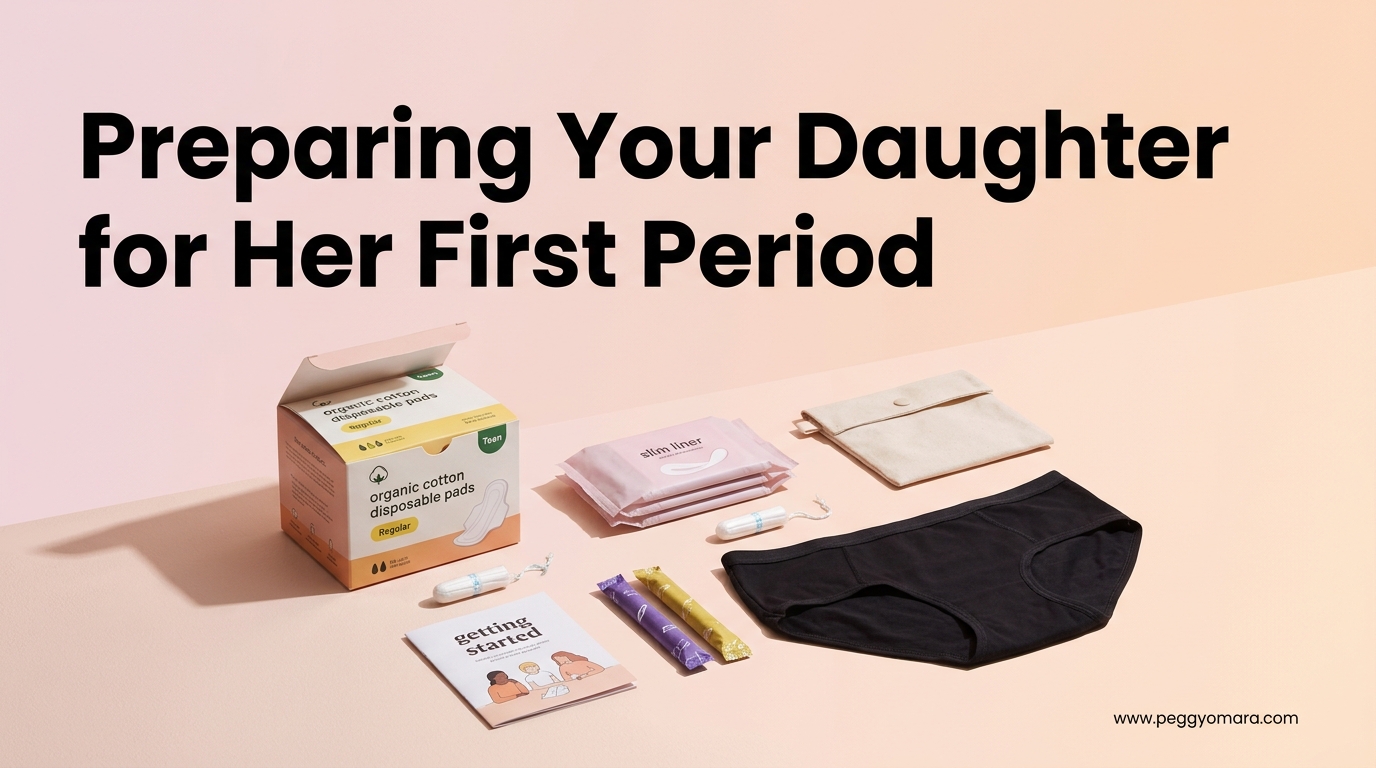
Practical Preparation: Building a Period Kit
Having supplies ready before the first period arrives reduces anxiety significantly. Here is what to include in a well-stocked period kit.
1. Pads in multiple absorbencies
Start with regular and heavy-flow pads. Avoid tampons for beginners until she is comfortable with her cycle. Period underwear is also an excellent first option.
2. Period underwear
These look like regular underwear but have built-in absorbency. Many parents find these less intimidating for first periods than traditional pads.
3. Wipes or gentle feminine wash
Helps with freshness, especially if changing pads at school. Choose unscented options to avoid irritation.
4. Plastic bags
Small zip-top bags for discreet disposal or for soiled underwear if leaks happen at school.
5. Pain relief
Teen-appropriate ibuprofen or acetaminophen, plus dosage instructions. A heating pad for home use also helps with cramps.
6. Change of underwear
Keep one or two pairs in her school bag or locker for emergencies.
7. Small pouch or bag
Something discreet that fits in a backpack. Let her choose it so she feels ownership.
School Preparation Tips
Talk to your daughter about school protocols. Does she know where the nurse’s office is? Is there a bathroom she prefers? Some parents send a note to the school nurse explaining their daughter may need support.
Identify a trusted female teacher or staff member she can approach if needed. Having a plan reduces the “what if it happens at school” anxiety.
What to Do When the First Period Arrives
Despite preparation, many girls are surprised when their first period actually starts. Your reaction in those first moments matters more than anything you have said before.
First 24 Hours Checklist
Stay calm and positive. Even if you are internally flustered, project calm confidence. Your reaction teaches her how to feel about this milestone.
Help her get set up with supplies. Show her how to use a pad if she has not practiced. Explain how often to change it (every 4-6 hours typically).
Answer her immediate questions. Is this normal? Yes. Will it hurt? Maybe mild cramping. How long will it last? Probably 3-7 days for this first one.
Normal First Period Characteristics
First periods are often lighter and shorter than future cycles. The flow may be brownish rather than bright red. Irregular cycles are completely normal for the first 1-2 years.
Pain varies. Some girls have no cramping; others have mild discomfort. Severe pain is not typical and worth mentioning to a doctor.
When to Keep Her Home
If she has significant cramping, very heavy flow, or simply feels overwhelmed, keeping her home for a day is reasonable. Do not make her feel guilty about this. Her comfort and confidence matter more than perfect attendance.
Making It Special: Celebrating This Milestone
Many cultures have traditions celebrating menarche as a transition to womanhood. Whether you follow specific cultural practices or create your own, acknowledging this milestone positively helps counter any shame or embarrassment your daughter may feel.
Celebration Ideas by Age and Personality
For younger girls (10-11): A special mother-daughter outing, a small gift like a journal or piece of jewelry, or a favorite meal at home. Keep it low-key and comfortable.
For older girls (12-14): A special dinner, a book about menstruation and body changes, or a “period kit” presented as a practical but thoughtful gift. Some families do small rituals like lighting a candle or sharing wisdom from female relatives.
For any age: Simply saying “I am proud of you for how you are handling this” goes a long way. Validation matters more than any gift.
The Red Tent Concept
Some families borrow from the Red Tent tradition of women gathering to honor cycles and transitions. This might mean inviting close female relatives or friends to share their own first period stories, creating community around the experience.
Keep in mind your daughter’s comfort level. Some girls love community celebration; others want privacy. Follow her lead.
When to See a Doctor
Most first periods are routine, but certain situations warrant medical attention. Use the 7-2-1 rule as a guideline.
The 7-2-1 Rule Explained
Seek medical advice if your daughter’s period:
7: Lasts longer than 7 days
2: Soaks through more than 2 pads per hour for 2 consecutive hours
1: Has not started by age 15, or there is a gap of more than 1 year between breast development and period starting
Other Warning Signs
Periods before age 8 may indicate precocious puberty and should be evaluated. Severe pain that prevents normal activities, periods more frequent than every 21 days or less frequent than every 45 days, or signs of anemia (extreme fatigue, pale skin) also warrant a doctor visit.
Trust your instincts. If something feels wrong, it is better to get checked than to worry at home.
Frequently Asked Questions
How do I prepare my daughter for her first period?
Start by having open conversations about puberty before signs appear. Build a period kit together with pads, period underwear, wipes, and a change of clothes. Teach her how to use products and what to expect. Focus on making menstruation feel normal and manageable rather than scary or shameful.
What is the 7 2 1 rule for menstruation?
The 7-2-1 rule helps parents know when to seek medical advice. Seek a doctor if periods last longer than 7 days, soak through more than 2 pads per hour for 2 hours, or have not started by age 15.
How do I make my daughter’s first period special?
Celebrate the milestone with a special outing, thoughtful gift, or family meal. Some families create Red Tent gatherings with female relatives. Keep it age-appropriate and follow your daughter’s comfort level. Even simple validation like saying ‘I am proud of you’ makes the moment positive.
What should I say when my daughter gets her first period?
Stay calm and positive. Say something like ‘This is completely normal and means your body is working exactly as it should. I am here to help you with whatever you need.’ Then help her get set up with supplies and answer her immediate questions without overwhelming her.
At what age should I start talking to my daughter about periods?
Start around age 8 or 9 with basic body concepts, even if puberty has not begun. By age 10, most girls benefit from knowing what to expect. Once breast development starts (usually the first sign of puberty), conversations should become more specific and preparation should begin in earnest.
How long does a first period typically last?
First periods usually last 3 to 7 days, though they are often shorter and lighter than future cycles. Flow may be irregular or brownish in color. Cycles may be unpredictable for the first 1-2 years as hormones establish a pattern.
Is it normal for periods to be irregular at first?
Yes, completely normal. The first 1-2 years of menstruation often involve irregular cycles, varying lengths, and unpredictable timing. It takes time for the hormonal system to establish a regular pattern. Most girls develop predictable cycles within 2-3 years of starting their period.
Can my daughter use tampons for her first period?
While tampons are physically safe to use at any age, most experts recommend starting with pads or period underwear for first periods. These are easier to manage and less intimidating. When your daughter feels comfortable with her cycle and is ready, she can try tampons with proper instruction.
Conclusion
Preparing your daughter for her first period is really about preparing yourself to be the calm, shame-free guide she needs. When you approach menstruation as a normal biological process and your daughter’s feelings as completely valid, you create space for her to develop a healthy relationship with her body.
Start the conversations early. Use clear, direct language. Have supplies ready before she needs them. And when that first period arrives, meet it with the confidence you want her to feel. The messages you send now will shape how she feels about her body for decades to come.
You have got this. And more importantly, she has got this too.