
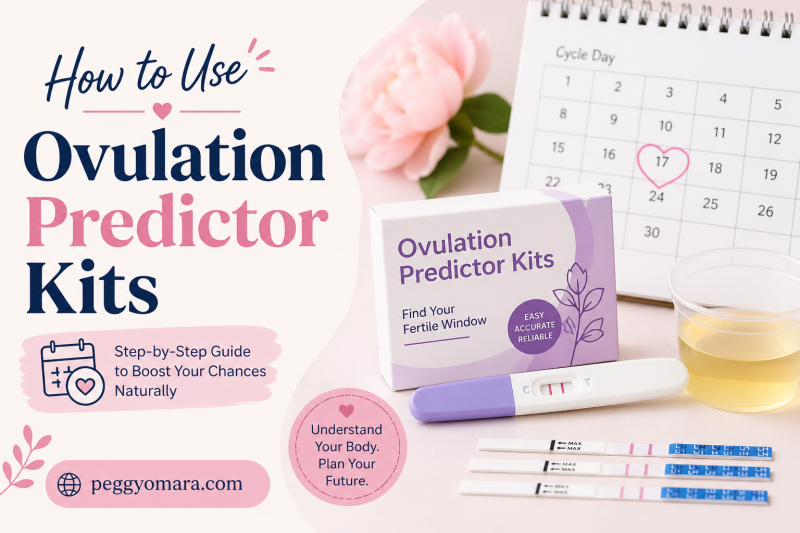
Staring at a faint line on an ovulation predictor kit, wondering if you’re imagining it darker than yesterday? You’re not alone. I have been there, squinting at test strips under different lighting, taking photos to compare, and feeling my stress levels climb with each cycle.
This guide will show you how to use ovulation predictor kits in a way that actually supports your fertility journey instead of turning it into an obsession. You will learn the science behind how these tests work, get clear step-by-step instructions, and most importantly, discover how to track your ovulation without losing your mind in the process.
Table of Contents
How Ovulation Predictor Kits Work (And Why They Can Feel Confusing)
Ovulation predictor kits detect the luteinizing hormone (LH) surge that happens 24 to 48 hours before your ovary releases an egg. Think of LH as your body’s ovulation alarm system. When levels spike, it triggers the release of a mature egg into your fallopian tube.
The confusion sets in because OPKs do not actually confirm that ovulation happened. They only tell you that your hormone levels suggest it is about to occur. Sometimes your body gears up for ovulation, the LH surge happens, but then ovulation does not actually follow through. This is completely normal but can be frustrating when you are trying to time everything perfectly.
Here are the key terms you need to know:
- LH surge: The rapid increase in luteinizing hormone that triggers ovulation
- Fertile window: The 5-6 day period when intercourse can lead to pregnancy, ending 24 hours after ovulation
- Peak fertility: The 2 days before ovulation when conception chances are highest
- Test line: The line on an OPK that must be as dark as or darker than the control line for a positive result
How to Use Ovulation Predictor Kits (Step-by-Step)
Using an ovulation predictor kit correctly is simpler than the internet makes it seem. Follow these steps and you will avoid most of the common pitfalls that drive people crazy.
Step 1: Know When to Start Testing
Begin testing about 17 days before you expect your next period, or around cycle day 10 if you have a typical 28-day cycle. If your cycles are irregular, start testing around cycle day 8 to avoid missing your surge.
For irregular cycles, use your shortest cycle length from the past 6 months as your guide. Subtract 17 from that number to find your starting day. So if your shortest cycle was 26 days, start testing on day 9.
Step 2: Choose Your Testing Time
The best time of day to use ovulation predictor kits is between 10 AM and 8 PM. Many people find late morning or early afternoon gives the most consistent results.
Avoid first morning urine for most OPK brands. Your LH surge typically begins in the morning but takes a few hours to show up in your urine. Testing with concentrated morning urine can actually give you a false negative when your surge is just beginning.
Step 3: Prepare for Accurate Testing
Reduce your fluid intake for about 2 hours before testing. Too much liquid dilutes your urine and can mask the LH surge, making your test line appear lighter than it should be. Also hold your urine for at least 1 hour before testing for the same reason.
Step 4: Take the Test
Collect urine in a clean, dry cup if using test strips, or hold a midstream digital test in your urine stream for the time specified in your kit’s instructions. Most strip tests need 5-10 seconds of submersion. Set a timer and do not over-soak.
Step 5: Read Your Results Correctly
Wait the full development time listed on your kit, usually 3 to 5 minutes, then read results immediately. Do not come back later to check, as evaporation lines can appear and confuse you.
A positive ovulation test shows a test line that is as dark as or darker than the control line. Unlike pregnancy tests, a faint line on an OPK does not mean positive. It means negative but getting closer. Wait for that unmistakable match or darkening.
Step 6: Track and Time Intercourse
When you get a positive result, plan intercourse within the next 24-48 hours. Better yet, start the day you see the positive and continue for the next 3-4 days to cover your full fertile window. Sperm can survive 3-5 days, so earlier is better than later.
The 3 Over 6 Rule and Other Timing Secrets
The 3 over 6 rule for ovulation refers to testing twice daily once you are in your likely fertile window. Test once between 10 AM and 2 PM, then again between 5 PM and 8 PM. This catches more surges, especially for people whose LH peak is brief.
Why twice daily matters: Some women have a rapid LH surge that peaks and falls within 12 hours. If you only test once daily, you might miss it entirely. Many users in fertility forums report that switching to twice-daily testing was the game-changer that finally gave them clear positives.
Here is a simple schedule that works:
- Days 8-12: Test once daily around 2 PM
- Days 13-16: Test twice daily, 10 AM and 6 PM
- After positive: Continue testing for 2-3 days to confirm the surge is dropping (optional but helpful for learning your pattern)
Common Mistakes That Make OPKs Feel Impossible
Knowing what not to do before taking an ovulation test saves you from the confusion and disappointment of inaccurate results. These mistakes trip up even experienced testers.
- Drinking too much water before testing is the number one error. I learned this the hard way after weeks of frustratingly light test lines. Your urine needs to be concentrated enough to detect the LH surge. Skip the water bottle for 2 hours before testing.
- Testing at the wrong time of day causes missed surges. First morning urine is usually too diluted for LH detection. The hormone needs time to build up in your system after you wake up.
- Reading results too early or too late creates false interpretations. Check at exactly the time your kit specifies. Early reading gives false negatives. Late reading shows evaporation lines that look positive but are not.
- Using expired tests or storing them improperly leads to unreliable results. Heat and humidity degrade test sensitivity. Store your strips in a cool, dry place and check expiration dates.
- Stopping after one positive can mean missing additional fertile days. Some women have multi-day surges. The first positive means ovulation is likely coming in 24-48 hours, but continuing to test confirms the pattern.
Keeping Your Sanity While Tracking (The Part Other Guides Miss)
This is where most fertility guides fail you. They tell you how to use the tests but ignore the emotional toll of constant tracking. Here is how to use ovulation predictor kits without driving yourself crazy.
Set Boundaries Around Testing
Pick specific times to test and stick to them. Do not test outside those windows. Do not test “just to see” after you have already gotten a positive. More testing does not equal more information, it equals more anxiety.
I recommend setting a phone alarm for your testing times. When it goes off, you test. When you are done, you put the kit away until the next scheduled time. This prevents the compulsive checking that leads to burnout.
Limit the Comparison Game
Stop photographing your tests and posting them in forums asking if the line looks darker. Stop comparing today’s test to yesterday’s for hours. A positive is a positive when the test line matches the control line. Everything else is just data noise that feeds anxiety.
If you must track progression, use an app like Premom that analyzes the line darkness for you. This removes your subjective squinting and second-guessing.
Communicate With Your Partner
The pressure of timed intercourse can strain relationships. Talk to your partner about how you are feeling. Explain that your hormone fluctuations might make you more emotional during the fertile window. Build intimacy outside of fertile days so sex does not feel like a scheduled medical procedure.
Some couples find it helpful to have a code word for when the test is positive, keeping the process lighter and less clinical.
Know When to Take a Break
If you find yourself testing multiple times daily outside your window, crying over faint lines, or feeling depressed when the test is negative, it is time to pause. Taking one cycle off from OPKs does not hurt your chances. Your mental health matters more than perfect timing.
Consider switching to a simpler method for a month, like tracking cervical mucus or using a fertility monitor that gives clear fertile/non-fertile readings.
Remember the Big Picture
A negative OPK today does not mean you failed. It means your body is not ready yet. The average couple takes 6-12 months to conceive even with perfect timing. One month of missed ovulation detection does not change your overall odds.
When to Stop Testing and Call Your Doctor
Sometimes OPKs genuinely do not work for your situation. Knowing when to seek help saves you months of frustration.
See your healthcare provider if:
- You have never gotten a positive OPK after 3 months of testing, especially if testing twice daily
- Your cycles are consistently shorter than 21 days or longer than 35 days
- You have PCOS and get multiple positive tests or constant faint lines
- You have been trying to conceive for 12 months (under age 35) or 6 months (age 35+)
- You experience severe pain mid-cycle that might indicate ovulation disorders
Some medical conditions make OPKs unreliable. Polycystic ovarian syndrome (PCOS) can cause elevated LH levels throughout your cycle, giving false positives. Luteinized Unruptured Follicle Syndrome (LUFS) causes LH surges without actual egg release. Certain fertility medications can also affect results.
Your doctor might suggest blood tests to confirm ovulation, ultrasound monitoring, or alternative tracking methods if standard OPKs are not working for you.
Frequently Asked Questions
What is the best time of day to use ovulation predictor kits?
The best time is between 10 AM and 8 PM, ideally late morning or early afternoon. Avoid first morning urine since LH takes a few hours after waking to appear in your urine. Test at the same time each day for consistent results.
What is the 3 over 6 rule for ovulation?
The 3 over 6 rule means testing twice daily during your likely fertile window, typically between cycle days 13-16. Test once between 10 AM and 2 PM, then again between 5 PM and 8 PM. This catches brief LH surges that single daily testing might miss.
What not to do before taking an ovulation test?
Do not drink large amounts of water for 2 hours before testing. Avoid testing with first morning urine. Do not read results before or after the specified time window. Avoid testing when extremely dehydrated. Do not use expired tests or strips stored in humid conditions.
Do ovulation predictor kits really work?
Yes, ovulation predictor kits are approximately 99% accurate at detecting the LH surge when used correctly. However, they detect hormone changes, not actual ovulation. Occasionally your body may prepare for ovulation but not release an egg. For most people with regular cycles, OPKs are highly reliable for predicting fertile windows.
Can ovulation predictor kits be wrong?
OPKs can give false negatives if you miss your brief LH surge by testing at the wrong time. False positives are less common but can occur with PCOS, perimenopause, certain medications like fertility drugs, or pregnancy. Expired or improperly stored tests may also give inaccurate results.
How many days after a positive OPK do you ovulate?
Most women ovulate 24 to 48 hours after their first positive ovulation test. Some ovulate as soon as 12 hours after, while others may take up to 72 hours. This is why starting intercourse on the day of your positive and continuing for the next 3-4 days maximizes your conception chances.
How to Use Ovulation Predictor Kits Without the Stress
Learning how to use ovulation predictor kits effectively is about balancing information with peace of mind. The tests work, the science is sound, and millions of people have used them successfully to conceive. But the process does not need to consume your thoughts or dictate your mood.
Set your testing schedule, follow the steps correctly, and then step away from the bathroom counter. Trust that your body is doing what it needs to do. Focus on the broader journey of preparing for parenthood, nurturing your relationship, and taking care of yourself.
If you have been tracking for months without success, or if the emotional toll is becoming too heavy, reach out to your healthcare provider. There is support available, medical options to explore, and no shame in needing help along the way. Your fertility journey is yours alone, and using OPKs should feel like a helpful tool, not a daily source of stress.