
Walking into your first fertility appointment can feel like stepping into the unknown. You might be holding years of hope, months of trying, and perhaps some anxiety about what comes next. Whether you have been trying to conceive for six months or several years, that first visit to a reproductive endocrinologist marks a significant step in your family-building journey.
I have spoken with countless individuals who describe this appointment as both terrifying and liberating. It is the moment when you stop wondering if something might be wrong and start getting real answers. What happens at your first fertility appointment is actually a carefully structured process designed to understand your unique situation and create a path forward.
In this guide, I will walk you through exactly what to expect, how to prepare both practically and emotionally, and how to advocate for yourself if you have ever felt dismissed by doctors in the past. You deserve to feel informed, supported, and empowered when you walk through those clinic doors.
Table of Contents
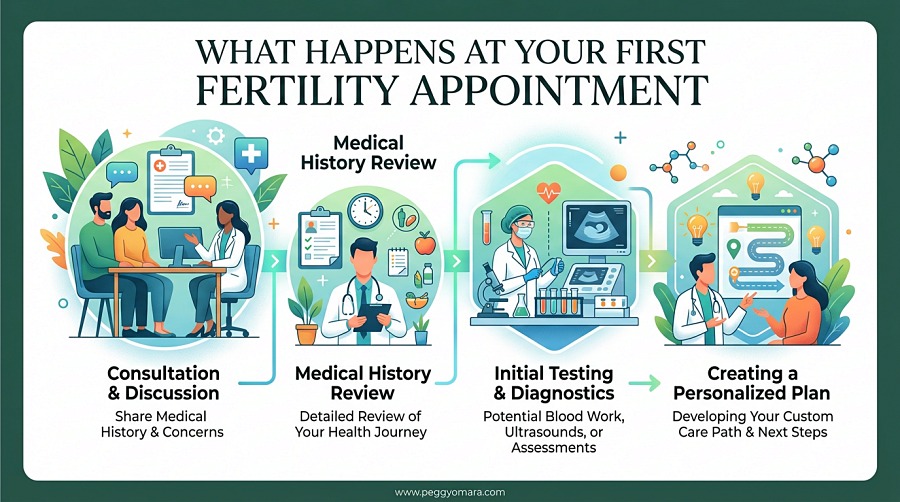
Quick Overview: Your First Fertility Appointment in 6 Steps
For those who want the highlights before diving deeper, here is what typically happens during your initial fertility consultation:
- Check-in and paperwork (15-20 minutes): Insurance verification, medical history forms, consent documents
- Meeting your fertility specialist (30-45 minutes): In-depth conversation about your history, concerns, and goals
- Medical history review: Detailed discussion of your cycle, previous pregnancies, surgeries, and health conditions
- Physical examination: Pelvic exam and transvaginal ultrasound to assess ovaries and uterus
- Testing discussion: Blood work orders for hormone levels, semen analysis for partners, possible HSG scheduling
- Treatment planning: Overview of options, timeline discussion, and next steps
Most first appointments take between 90 minutes and two hours. Some clinics split this into separate visits if extensive testing is needed immediately. Bring a notebook, ask questions, and remember that this is your time to gather information.
What Happens at Your First Fertility Appointment: A Complete Walkthrough
Understanding each phase of your appointment can reduce anxiety and help you feel more prepared. Let me break down exactly what you will experience from the moment you arrive.
Arrival and Check-In: What to Expect When You Walk In
Fertility clinics operate differently from a typical OB/GYN office. The waiting room might feel more private, with appointments staggered to protect patient confidentiality. When you check in, you will complete several forms including your medical history, insurance information, and consent for treatment.
Many clinics also ask about your family-building goals and any previous fertility treatments. Be prepared to provide your insurance card and a form of identification. If you have brought medical records from previous doctors, the front desk will typically make copies for your chart.
The waiting time varies, but most fertility specialists schedule longer initial consultations than standard OB/GYN visits. Expect to be in the office for 90 minutes to two hours total. Some people bring a book or headphones, though many find they are too nervous to focus on anything but the appointment ahead.
Meeting Your Reproductive Endocrinologist
A reproductive endocrinologist is a physician who specializes in hormonal disorders and fertility. These doctors complete additional training beyond standard OB/GYN residency to become fertility specialists. Their expertise covers both female and male reproductive health.
Your first conversation will likely feel more like an interview than a typical doctor visit. They want to understand your story, your timeline, and what has brought you to their office. Do not minimize your concerns or downplay your emotional experience. This doctor needs the full picture to help you effectively.
Many patients tell me they worried about being judged for waiting “too long” to seek help or for seeking help “too soon.” There is no judgment here. Whether you are 28 or 42, whether you have been trying for six months or three years, your concerns are valid and this appointment is the right step.
The Detailed Medical History Review
Your fertility specialist will review every aspect of your health history that could impact conception. This includes your menstrual cycle patterns, any previous pregnancies (including miscarriages or ectopic pregnancies), and any surgeries involving your reproductive organs.
They will also ask about chronic health conditions like thyroid disorders, diabetes, or endometriosis. Bring a list of all medications and supplements you currently take. Even over-the-counter supplements can affect fertility, so full disclosure matters.
Your partner’s health history matters too. If your partner is male, the doctor will ask about testicular injuries, infections, surgeries, and any history of fertility issues. Male factor infertility contributes to approximately 40% of infertility cases, so this information is equally important.
The conversation will also cover lifestyle factors. Expect questions about smoking, alcohol consumption, caffeine intake, exercise habits, and stress levels. These factors do not exist in isolation but interact with your overall fertility picture.
Initial Physical Examination and Ultrasound
Most initial fertility appointments include a physical examination. For women, this typically involves a pelvic exam similar to what you experience at your annual OB/GYN visit. The doctor is checking for any obvious physical abnormalities, signs of endometriosis, or other issues.
The transvaginal ultrasound is a standard part of most first fertility appointments. This internal ultrasound uses a slender probe to create images of your ovaries and uterus. It allows the doctor to assess your ovarian reserve by counting antral follicles, which are small fluid-filled sacs containing immature eggs.
The ultrasound also examines your uterine lining and checks for fibroids, polyps, or other structural issues that could affect implantation. While the procedure can feel uncomfortable, it should not be painful. Let your technician know if you experience significant discomfort.
For partners, a physical examination may also be performed, though the semen analysis is typically the primary diagnostic tool for male factor assessment. This test is usually scheduled separately to allow for proper preparation.
Blood Work and Diagnostic Testing Discussion
Blood tests are essential for evaluating your hormone levels and ovarian reserve. Your doctor will likely order several tests, which may be drawn during your appointment or scheduled for a specific day of your cycle.
Day 3 blood work tests follicle-stimulating hormone (FSH) and estradiol levels. These indicate how hard your body is working to stimulate egg development. Anti-Mullerian hormone (AMH) testing can be done any time during your cycle and provides a picture of your remaining egg supply.
Progesterone testing typically occurs around day 21 of your cycle to confirm ovulation. Thyroid function tests and prolactin levels are also commonly checked, as both can affect fertility. Your doctor will explain which tests you need and when to schedule them.
Additional diagnostic tests may be discussed during your first appointment. The hysterosalpingogram (HSG) is an X-ray procedure that checks whether your fallopian tubes are open and evaluates the shape of your uterine cavity. A saline sonogram uses ultrasound with salt water to get a clearer picture of the uterine lining. These tests are usually scheduled for after your initial consultation.
For male partners, semen analysis is the cornerstone fertility test. This evaluates sperm count, motility (movement), and morphology (shape). Your doctor will explain collection procedures and timing requirements, as abstinence periods affect results.
Creating Your Personalized Treatment Plan
After reviewing your history and possibly preliminary test results, your fertility specialist will discuss treatment options. This is not a one-size-fits-all conversation. Your age, diagnosis, personal preferences, and family-building goals all factor into the recommendations.
Common treatment pathways include fertility medications like Clomid or Letrozole to stimulate ovulation, intrauterine insemination (IUI) which places sperm directly into the uterus, and in vitro fertilization (IVF) which involves egg retrieval and embryo transfer. Some patients may also discuss fertility preservation through egg freezing.
Your doctor should explain success rates for your specific situation, not just general clinic statistics. Ask about the expected timeline, how many cycles of each treatment might be recommended, and what the monitoring process involves. Understanding these logistics helps you plan both practically and emotionally.
Before you leave, you should have a clear understanding of next steps. This might include scheduling follow-up tests, starting a treatment protocol, or returning for a follow-up consultation once results are complete. Ask for written materials or a summary you can reference later.
How to Prepare for Your First Fertility Appointment
Preparation transforms anxiety into confidence. When you walk in with organized information and thoughtful questions, you demonstrate to your doctor that you are an engaged partner in your care. Here is how to get ready.
Documents and Records to Bring
Creating a fertility folder before your appointment saves time and ensures you have everything you need. Start with your insurance card and a list of all current medications including dosages. Include over-the-counter supplements and vitamins.
Gather any previous test results related to fertility. This includes previous semen analyses, hormone blood work, hysterosalpingogram results, or genetic testing. If you have had surgery on your reproductive organs, bring those records too.
Write down key dates: when you started trying to conceive, significant cycle changes, dates of previous pregnancies or miscarriages, and any relevant medical events. This timeline helps your doctor see patterns that might not be obvious from individual test results.
Contact your insurance company before the appointment to understand your fertility coverage. Ask about prior authorization requirements, covered treatments, and your deductible status. Some clinics have financial counselors who can help navigate this, but knowing your coverage beforehand helps you ask informed questions.
Track Your Cycle Before You Go
If you have not already been tracking your menstrual cycle, start now. Your fertility specialist will want detailed information about cycle length, flow characteristics, and any mid-cycle symptoms that might indicate ovulation.
Basal body temperature tracking shows whether you are ovulating by measuring the slight temperature increase that occurs after ovulation. Ovulation predictor kits detect the luteinizing hormone surge that triggers egg release. Period tracking apps can organize this data into charts your doctor can review.
Even a few months of tracking provides valuable baseline data. If your cycles are irregular, that information alone helps your doctor understand part of the fertility picture. Bring your charts or app data to the appointment.
Do not worry if you have not been tracking rigorously. Your doctor will help you understand what to monitor going forward. Some diagnostic tests require specific cycle timing, so you may need to track more carefully after this appointment.
Questions to Write Down Beforehand
Walking into a fertility appointment with a prepared question list ensures you do not forget important concerns in the moment. Organize your questions by category to make the conversation flow naturally.
Questions about testing might include: What specific tests do you recommend for our situation? How long will results take? Will my partner need testing too? Are there genetic tests we should consider?
Treatment questions could cover: What treatment options are appropriate for our diagnosis? What are the success rates for someone my age? How many cycles do you typically recommend before moving to the next option? What are the side effects of recommended medications?
Timeline and logistics questions matter too: How quickly can we begin treatment? How much monitoring is required? Do you offer telehealth for follow-ups? What is your availability for questions between appointments?
Financial questions, while uncomfortable, are essential: What will insurance cover? What are the out-of-pocket costs for recommended treatments? Do you offer payment plans or financial counseling? Are there ways to reduce costs without compromising care?
Preparing Your Partner
Deciding whether your partner should attend the first appointment depends on your specific situation and clinic policies. Many clinics encourage partner attendance for the initial consultation because fertility treatment decisions affect both of you.
If your partner is male and will be providing a semen sample for analysis, they will need to follow specific preparation guidelines. This typically includes two to five days of abstinence before the test. Your clinic will provide detailed instructions about collection procedures and timing.
Even if your partner cannot attend the first appointment, find ways to include them in the preparation process. Share this article, discuss your questions together, and establish how you will communicate about appointments and decisions.
Fertility treatment can strain even strong relationships. Starting with open communication and shared understanding helps you navigate the emotional and practical challenges ahead as a team.
Emotional Preparation: Taking Care of Your Mental Health
The medical aspects of fertility treatment are only half the story. Your emotional well-being matters just as much as your hormone levels. Preparing your mind and heart for this appointment is as important as gathering your medical records.
Managing Anxiety Before Your Visit
It is completely normal to feel nervous before your first fertility appointment. Many people worry about receiving bad news, feeling judged, or hearing that their dreams of parenthood are impossible. These fears are valid, but they do not have to control your experience.
Practice deep breathing before you arrive. Box breathing, where you inhale for four counts, hold for four, exhale for four, and hold for four, activates your parasympathetic nervous system and reduces anxiety. Arrive early enough that you are not rushed, but not so early that you sit waiting for an extended period.
Bring a support person if your clinic allows it. Having a partner, friend, or family member present provides emotional support and an extra set of ears to catch information you might miss. They can also take notes while you focus on the conversation.
Prepare yourself for the possibility of inconclusive results. Many first appointments end with more questions than answers, as testing takes time. This does not mean your doctor is failing you. It means they are being thorough before recommending treatment.
If You Have Been Dismissed Before: How to Advocate for Yourself
One of the most heartbreaking experiences in fertility care is being dismissed by previous doctors. Many people, especially women, report being told to “just relax,” “keep trying,” or “come back after a year” when they know something is wrong. If this describes your experience, you are not alone.
Your first fertility appointment is your opportunity to be heard. A reproductive endocrinologist specializes in the very concerns other doctors might have minimized. Come prepared with specific language: “I have been concerned about my irregular cycles for two years. My previous doctor dismissed this, but I believe it indicates an underlying issue.”
If a previous doctor refused testing you requested, mention this directly: “I asked for AMH testing six months ago and was told I was too young to worry. Given my family history, I would like that test now.” Specific advocacy language is harder to dismiss than general complaints.
Remember that you are hiring this doctor to provide a service. If you feel dismissed, unheard, or uncomfortable during the first appointment, you have every right to seek a second opinion. The best fertility specialist for you is one who listens, explains, and treats you as a partner in your care.
Trust your instincts about your body. You know your experience better than anyone. A good fertility specialist will validate your concerns and work with you to find answers, not dismiss your lived experience.
Frequently Asked Questions About Your First Fertility Appointment
Can I go to my fertility appointment while on my period?
Yes, you can absolutely attend your first fertility appointment while menstruating. In fact, some testing like baseline hormone blood work and antral follicle count ultrasounds are ideally performed on day 2 or 3 of your cycle. Your doctor will let you know if specific timing is needed for any tests they order.
How long does the first fertility appointment take?
Most initial fertility consultations take between 90 minutes and two hours. This includes check-in, consultation with your reproductive endocrinologist, physical examination, and ultrasound. Some clinics split this into multiple visits if extensive testing is needed immediately.
Should my partner come to the first appointment?
Many fertility clinics encourage partners to attend the initial consultation. Fertility treatment decisions affect both partners, and having both people present ensures everyone hears the same information. Male partners can also discuss semen analysis requirements and timing with the doctor directly.
What tests will they do at the first visit?
The first appointment typically includes a physical exam, transvaginal ultrasound, and discussion of blood tests. Common blood work includes AMH, FSH, estradiol, and progesterone testing. Your partner may need a semen analysis. Additional tests like HSG or saline sonogram are usually scheduled separately.
How soon after the consultation can we start treatment?
Treatment timing depends on your test results and where you are in your menstrual cycle. Some patients can start fertility medications or IUI in the same month as their consultation. Others may need to complete diagnostic testing first, which could delay treatment by one to two cycles.
Final Thoughts: You Are Taking an Important Step
Your first fertility appointment represents courage. You are moving from uncertainty toward answers, from worry toward action. What happens at your first fertility appointment is the beginning of understanding your body better and creating a plan that aligns with your family-building goals.
Remember that fertility treatment is rarely a straight line. There may be unexpected findings, emotional moments, and decisions that feel overwhelming. But you do not have to navigate this alone. Your reproductive endocrinologist, clinic staff, and support network are resources for the journey ahead.
As you prepare for this appointment, hold onto hope while staying grounded in reality. Many people who once sat where you are sitting now have the families they dreamed of. Some took unexpected paths to get there, but the first step was always the same: walking through those clinic doors and asking for help.
You are ready for this. You are stronger than your anxiety suggests. And you deserve the answers you seek.