
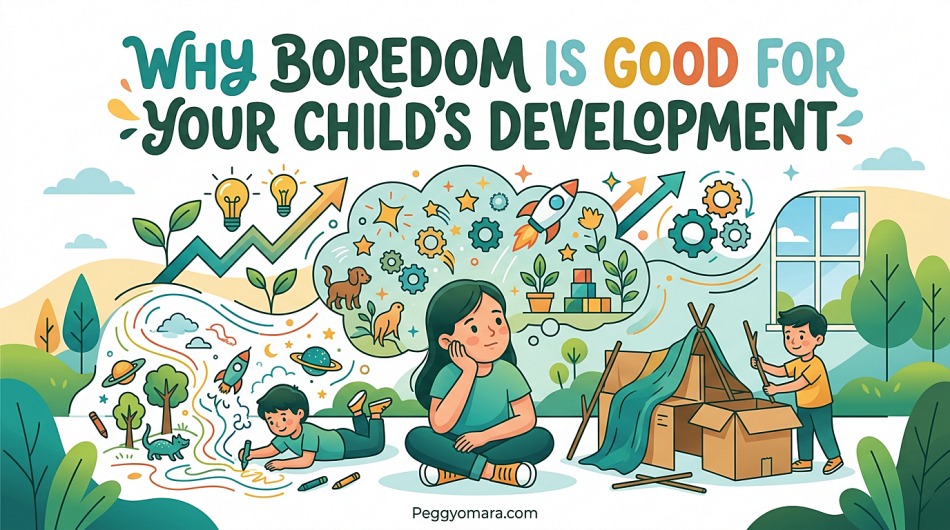
Yes, boredom is actually good for your child’s development. Research from psychologists and neuroscientists consistently shows that experiencing boredom helps children develop essential life skills including creativity, problem-solving, emotional regulation, and independence. When kids learn to navigate those uncomfortable “I’m bored” moments themselves, they build neural pathways that support healthy cognitive and emotional growth.
As parents, we’ve all heard those two dreaded words: “I’m bored.” Our instinct is often to jump in with solutions, activities, or screen time to make the discomfort go away. But that well-meaning impulse might actually be robbing our children of valuable developmental opportunities.
In this guide, I’ll share what science tells us about why boredom benefits kids, the specific skills it helps develop, and practical strategies for handling those boredom complaints without fixing everything for your child.
Table of Contents
The Science Behind Why Boredom Benefits Development
Boredom is not just an inconvenience to eliminate. Neuroscience research reveals that boredom serves an important biological function. Dr. Erin Westgate, a psychology researcher at the University of Florida, found that boredom is a signal that our current activity isn’t engaging us meaningfully. For children, this signal becomes a catalyst for growth.
When kids experience boredom, their brains do something remarkable. Research from Linda Caldwell and her colleagues at Penn State University shows that unstructured time allows children’s brains to consolidate past experiences and learning. Think of it as mental digestion time. Just as our bodies need rest to process food, our brains need downtime to process information and experiences.
Neuroscientists have discovered that boredom activates the brain’s default mode network. This network is responsible for daydreaming, imagination, and creative problem-solving. When children are constantly entertained, this network never gets activated. The result? Missed opportunities for the brain to strengthen neural pathways that support innovation and independent thinking.
Dr. Jamie Jirout, a curiosity researcher at the University of Virginia, emphasizes that safe stretches of unstructured time are essential for developing self-directed learning skills. When children must figure out how to occupy themselves, they’re practicing executive function skills that predict academic and life success.
Why Boredom is Actually Good for Your Child’s Development
Boredom offers five key developmental benefits that structured activities simply cannot replicate. These benefits build on each other, creating a foundation for resilient, creative, and emotionally healthy children.
Boredom Builds Creativity and Imagination
When children have nothing to do, their minds naturally start creating. A bored child staring at a blank wall might begin imagining a castle, a spaceship, or an adventure. This mental wandering is where creativity is born.
Einstein reportedly said, “Creativity is the residue of time wasted.” While we can’t verify this exact quote, the sentiment aligns perfectly with what creativity researchers have found. Dr. Sandi Mann, a psychologist who studies boredom at the University of Central Lancashire, discovered that people who completed a boring task before a creative one actually performed better on the creative task. Boredom primes the brain for innovation.
In my own family, I’ve noticed this pattern repeatedly. The days when we have no scheduled activities are precisely when my children create elaborate games, build forts from cardboard boxes, or write stories. The unstructured time forces them to become the architects of their own entertainment.
Boredom Develops Problem-Solving Skills
When a child says “I’m bored,” they’re essentially presenting themselves with a problem to solve. The challenge: How do I make this time interesting? Children who regularly work through boredom develop planning strategies and flexibility that serve them throughout life.
Research published in the journal Academy of Management Discoveries found that boredom can spark productivity and problem-solving. The study participants who were bored before a task found more creative solutions than those who weren’t. For children, this translates into developing critical thinking skills early.
A child facing boredom must evaluate options, make decisions, and execute plans. Should I draw? Build with blocks? Read a book? Each choice requires assessing resources, predicting outcomes, and adapting if the first attempt fails. These are exactly the skills employers prize in adults.
Boredom Strengthens Emotional Regulation
Boredom is uncomfortable. That’s precisely why it’s valuable. Learning to tolerate that uncomfortable feeling without immediately escaping it builds emotional resilience and frustration tolerance.
Dr. Lisa Damour, a clinical psychologist and author, explains that boredom teaches children emotional granularity. This is the ability to identify and name different emotional states accurately. When a child can distinguish between bored, lonely, restless, or tired, they gain tools to manage those feelings appropriately.
The New York Times parenting section introduced the helpful metaphor of boredom as a dashboard indicator light. Just as a car’s warning light tells you something needs attention, boredom signals that a child’s current situation isn’t meeting their needs. Teaching children to read this signal helps them develop emotional intelligence. They learn to ask: What do I actually need right now?
Kids who never experience boredom often develop low tolerance for any uncomfortable emotion. They may become adults who need constant distraction, struggle with delayed gratification, or avoid challenges that require patience.
Boredom Fosters Independence and Self-Esteem
Perhaps the most significant benefit of boredom is the independence it cultivates. When children solve their own boredom, they discover they are capable of entertaining themselves. This builds self-reliance and confidence.
Psychologists call this “self-efficacy” – the belief that you can handle challenges yourself. Children with high self-efficacy are more likely to try new things, persist through difficulties, and recover from setbacks. Boredom is one of the first opportunities young children have to build this crucial trait.
There’s a particular pride children feel when they create something from nothing. The fort built from cushions, the story written in a notebook, the dance routine invented in the living room. These self-directed achievements matter more than any organized activity because they belong entirely to the child.
Dr. Eshleman from Cleveland Clinic emphasizes that when children find ways to entertain themselves, it fosters creativity, independence, and imagination. These are foundational traits for healthy development that cannot be taught directly. They must be discovered through experience.
Boredom Gives the Brain Time to Consolidate
Modern childhood is often overscheduled. School, sports, music lessons, tutoring, playdates. While these activities have value, they leave little time for the brain’s essential maintenance work.
Neuroscience research reveals that the brain needs downtime to consolidate learning. When children have unstructured time, their brains process and organize information from previous experiences. This consolidation is essential for memory formation and skill mastery.
Think about how you solve complex problems. Often, the solution comes not when you’re actively thinking about it, but in the shower, on a walk, or doing something mundane. Boredom creates similar conditions for children’s brains. The quiet periods allow new connections to form and insights to emerge.
Dr. Alison Gopnik, a developmental psychologist at UC Berkeley, notes that children are constantly learning and updating their models of how the world works. Downtime is when this updating happens. Without it, children accumulate experiences without fully integrating them.
How to Handle ‘I’m Bored’: Practical Strategies for Parents
Understanding boredom’s benefits is one thing. Actually handling a whining child announcing they’re bored for the tenth time in an afternoon is another. Here are practical, research-backed strategies that honor both your sanity and your child’s development.
Don’t Rush to Fix It
The first and most important strategy is simple: resist the urge to immediately solve your child’s boredom. That uncomfortable pause between “I’m bored” and finding something to do is where the magic happens.
Try responding with empathy but not solutions. “Yeah, being bored is uncomfortable sometimes” or “I hear you. I’m confident you’ll figure out something interesting to do.” Then return to your own activity. This response validates their feelings while communicating your confidence in their ability to solve the problem.
The Child Mind Institute recommends this approach based on clinical observations. Children who are allowed to sit with boredom for even 10-15 minutes often find their way to creative play. The key is parental patience during that uncomfortable transition period.
This doesn’t mean ignoring your child entirely. Stay nearby, available if needed, but occupied with your own task. Your presence provides safety while your non-intervention provides opportunity.
Create an ‘Activity Menu’
For children who genuinely struggle with where to start, an activity menu can help without taking over their decision-making. This is a list of approved activities they can choose from independently.
The key is creating the menu together during a calm moment, not in the heat of boredom frustration. Include a mix of options: art supplies, building materials, books, outdoor equipment, and open-ended toys. Write or draw the options so even pre-readers can use the menu.
Age-specific suggestions work best. For younger children (ages 2-5), include simple sensory activities like play dough, water play, or building blocks. School-age children (6-12) might benefit from options like LEGO, craft supplies, or science kits. Teenagers can handle more complex projects: learning a new skill, creative writing, or DIY projects.
The activity menu isn’t a crutch that prevents boredom problem-solving. It’s a temporary bridge while children develop those skills. Over time, most children need the menu less frequently as they internalize the habit of generating their own ideas.
Distinguish Boredom from Attention-Seeking
Sometimes “I’m bored” actually means “I want your attention.” Learning to distinguish between the two helps you respond appropriately without accidentally reinforcing attention-seeking behavior.
Genuine boredom usually happens when children have open time and space. They might wander around, look at different toys or activities, and seem genuinely uncertain about what to do. Attention-seeking boredom often happens when you’re clearly occupied with something else. The complaint is frequent, dramatic, and stops the moment you engage directly.
For attention-seeking “boredom,” the best response is brief acknowledgment followed by a plan for later connection. “I can tell you want to spend time together. I’m finishing this task now, and then we’ll read together for 20 minutes.” This honors their need while not derailing your current activity.
Dr. Stephanie Lee, a clinical psychologist at the Child Mind Institute, notes that attention-seeking behavior often increases initially when parents change their response. This temporary escalation is normal and should be met with consistency rather than surrender.
Set Up Boredom-Friendly Spaces
The physical environment matters. A space filled only with electronic toys that do one thing won’t inspire creative play. Neither will a space so organized that children feel they can’t touch anything.
Create areas that invite exploration. A craft corner with accessible supplies. A building area with blocks, cardboard, and tape. A cozy reading nook. An outdoor space with loose parts like sticks, stones, and pinecones. These environments suggest possibilities without dictating specific activities.
Rotate toys and materials periodically. Research shows that children play more creatively with fewer toys. When you rotate what’s available, old items feel new again. This simple strategy reduces the “there’s nothing to do” complaints without buying anything.
The goal is an environment that whispers invitations rather than shouting instructions. Children should feel free to explore, make messes, and create without constant adult direction or correction.
Model Comfort with Stillness
Children learn more from what we do than what we say. If every adult moment is filled with screens, tasks, or entertainment, children absorb the message that stillness is something to avoid.
Let your children see you being comfortable with quiet time. Read a book. Sit and watch the clouds. Work on a hobby that doesn’t involve a screen. When you’re waiting somewhere, resist the immediate phone grab. These modeled behaviors teach more than any lecture about boredom’s benefits.
Share your own experiences with boredom. “I had some free time this morning and didn’t know what to do with myself. At first I felt restless, but then I started sketching and really enjoyed it.” This normalizes the discomfort of boredom and shows that working through it leads to good outcomes.
Remember that we’re asking children to develop a skill many adults struggle with. Our culture increasingly pathologizes stillness, treating every unoccupied moment as a problem to solve with content consumption. Reclaiming comfort with boredom is a gift we give ourselves as well as our children.
Age-Appropriate Boredom: From Toddlers to Teens
Boredom looks different at different developmental stages. What works for a preschooler won’t satisfy a teenager. Here’s how to approach boredom across age groups.
Ages 2-5: Preschoolers
Young children need shorter periods of unstructured time. Their attention spans are developing, and they may need more support initially to discover independent play.
Start with 15-20 minute blocks of quiet time. Use visual timers so children can see when the period will end. Stay nearby but engaged in your own calm activity. Having special “quiet time toys” that only come out during these periods can increase engagement.
Open-ended materials work best for this age: blocks, play dough, dress-up clothes, simple art supplies. Avoid toys that do only one thing or make all the sounds themselves. The goal is materials that require the child to supply the imagination.
Don’t expect complete independence immediately. Young children may need occasional suggestions or help getting started. The aim is gradually increasing their comfort with self-directed play, not immediate perfection.
Ages 6-12: School Age
School-age children are ready for longer periods of unstructured time and more complex independent projects. This is the sweet spot for boredom’s benefits to really develop.
Children this age can handle 30-60 minutes of unstructured time, especially during weekends and breaks. The activity menu strategy works particularly well for this group. They have enough skills to execute ideas independently but may need help generating initial options.
This age also brings more complex complaints. “I’m bored” might mean “I want screen time” or “My friends aren’t available.” Stay consistent with boundaries while acknowledging the disappointment. “I know you’d rather play video games. The screen time limit is still 30 minutes today. I’m interested to see what you come up with instead.”
Summer breaks are prime boredom territory for this age group. Resist the urge to fill every week with camps and activities. Those empty weeks are when deep, creative play develops. The initial complaints are usually loudest in the first few days of a break, then creativity kicks in.
Ages 13+: Teenagers
Teenagers need a different approach to boredom. They have the capacity for longer periods of unstructured time and deeper reflection. However, they also face intense social pressure and screen temptations.
Boredom for teens can lead to creative projects, skill development, or simply needed mental rest. Many teenagers are chronically overscheduled and sleep-deprived. Boredom might be their brain’s signal that it needs downtime, not more activity.
Support teen boredom by providing resources without demands. Art supplies, musical instruments, tools, books on interesting topics. Let them discover their own passions rather than filling their time with structured enrichment activities.
Have conversations about the difference between boredom and isolation. Teenagers need social connection, and prolonged social isolation isn’t healthy boredom. Help them distinguish between “I need human connection” and “I need to learn to entertain myself.”
Healthy Boredom vs. Harmful Understimulation
An important distinction exists between healthy boredom and harmful understimulation. Understanding this difference helps parents navigate appropriate boundaries.
Healthy boredom occurs in children who have adequate stimulation overall but are experiencing a temporary lull. They have access to age-appropriate materials, social connection, and activities. The boredom is a natural pause, not a chronic condition.
Harmful understimulation occurs when children consistently lack the resources, attention, or environment needed for healthy development. This is neglect, not beneficial boredom. Signs include: children unable to engage even when offered activities, regression in skills, or extreme lethargy.
The difference often lies in the context. Is this a temporary state in an otherwise engaged life? Or is this a chronic pattern? Healthy boredom is a contrast to busy days. Understimulation is persistent emptiness.
Trust your instincts as a parent. You know your child’s baseline. If a normally engaged child says they’re bored on a rainy Saturday, that’s healthy. If a child seems disconnected from everything for weeks, that warrants attention.
The Historical Context: How Childhood Changed
Understanding why boredom feels so uncomfortable to modern parents requires looking at how childhood has changed over generations.
Baby boomers and Generation X adults often recall childhoods filled with unstructured time. Summer days without camps, hours of neighborhood play without adult organization, and long stretches of self-entertainment were normal. Boredom was simply part of life, not a parenting failure.
Today’s children experience a dramatically different reality. The average American child has only 4-7 minutes of unstructured outdoor play per day. School schedules are packed. After-school hours fill with activities. Screens offer constant entertainment at the swipe of a finger. Boredom has become unfamiliar, and the unfamiliar feels uncomfortable.
Dr. Alvin Rosenfeld, a child psychiatrist who writes about over-parenting, notes that modern parents often feel pressure to maximize every moment of their child’s life. The culture of “optimization” treats childhood as a product to be perfected rather than a life to be lived. Boredom becomes the enemy in this framework.
The Surgeon General’s recent advisory on parental stress highlights how this pressure affects families. Parents feel guilty when they’re not constantly enriching their children. This guilt drives over-scheduling, which eliminates boredom, which eliminates the developmental benefits we’ve been discussing. Breaking this cycle requires cultural shifts as well as individual choices.
Addressing Parental Guilt and Over-Parenting Culture
The hardest part of letting kids be bored isn’t the child’s complaint. It’s the parent’s guilt. We worry we’re failing, neglecting, or disadvantaging our children by not filling their time.
This guilt reflects a cultural shift toward intensive parenting. Research by sociologists shows that modern parents, particularly mothers, spend significantly more time on childcare activities than parents did in the 1960s. Yet this increased investment hasn’t necessarily produced happier or more successful children.
Reframe boredom as a gift, not a deprivation. When you let your child be bored, you’re giving them the opportunity to develop creativity, resilience, and independence. These qualities will serve them far longer than any single activity you could schedule.
Remember that struggle is part of growth. We don’t prevent developmental progress in other areas. We let babies struggle to roll over, toddlers struggle to walk, and preschoolers struggle to write. Why do we prevent the productive struggle of boredom?
You’re not alone in this challenge. Every parent navigating this culture of constant entertainment faces similar pressures. Finding a community of parents who value unstructured time can provide support and validation for your choices.
FAQs
Is boredom actually good for kids?
Yes, boredom is good for children’s development. Research shows that experiencing boredom helps kids develop creativity, problem-solving skills, emotional regulation, independence, and self-esteem. When children work through boredom themselves, they learn to manage their emotions, find meaningful activities, and build neural pathways that support healthy cognitive development.
What is the 7 7 7 rule in parenting?
The 7-7-7 rule in parenting suggests that parents should ask three questions when making decisions: How will this matter in 7 minutes? How will this matter in 7 months? How will this matter in 7 years? This framework helps parents gain perspective on daily parenting challenges and avoid overreacting to temporary situations like boredom complaints.
What is the 10-10-10 rule for kids?
The 10-10-10 rule is a decision-making framework where you ask: How will this matter in 10 minutes? How will this matter in 10 months? How will this matter in 10 years? For children, parents can adapt this to help kids think through choices and gain perspective on current frustrations like boredom.
What did Einstein say about boredom?
Einstein is often quoted as saying, ‘Creativity is the residue of time wasted.’ While the exact quote cannot be verified, the sentiment aligns with creativity research. Studies show that people who experience boredom before creative tasks often perform better, as boredom primes the brain for innovation and imagination.
How long should I let my child be bored?
The appropriate duration depends on age. Preschoolers (ages 2-5) can start with 15-20 minutes of unstructured time. School-age children (6-12) can handle 30-60 minutes. Teenagers can benefit from longer periods of several hours. The key is starting small and gradually increasing as your child develops comfort with independent play.
What is the difference between healthy boredom and understimulation?
Healthy boredom is a temporary pause in an otherwise engaged life where a child has access to resources and activities but is experiencing a lull. Harmful understimulation is chronic and occurs when children consistently lack resources, attention, or environment needed for development. Healthy boredom leads to creative solutions; understimulation leads to withdrawal or regression.
Embracing Boredom for Happier, More Resilient Children
Boredom is not the enemy of a happy childhood. It’s a gateway to creativity, resilience, independence, and emotional health. When we protect our children from every moment of discomfort, we rob them of the opportunity to develop these essential qualities.
The research is clear. Boredom is actually good for your child’s development. It builds neural pathways for creativity. It strengthens problem-solving muscles. It teaches emotional regulation. It fosters the independence and self-esteem that will serve children throughout their lives.
Our job as parents isn’t to eliminate every uncomfortable moment. It’s to provide the safety and support that allows children to navigate those moments themselves. The next time you hear those two little words – “I’m bored” – take a breath. Smile. And trust that something wonderful might be about to happen, if you just give it time.
Start small. Create one boredom-friendly space in your home. Let one afternoon a week remain unscheduled. Model comfort with stillness yourself. These simple shifts can transform how your family experiences unstructured time. The gifts of boredom – creativity, resilience, and independence – are worth the temporary discomfort of hearing “I’m bored.”